Saturday, November 24, 2012
5 Ways to Teach Your Child to Pay Attention
Saturday, July 28, 2012
Motivation, Reluctance, and the Circus
Wednesday, June 27, 2012
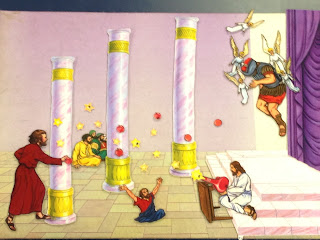
Joshua Fought the Battle of...the Flannelboard!
Josh is now a young adult, but he still remembers the flannel board stories with great fondness. He remembers making up many adventurous tales and having a lot of flannel pieces to work with from our large Bible flannel set. His favorite, he recalls, was the time he put the kneeling Jesus figure behind a large clay jar on a table turned on its side to provide cover. From that position, Jesus proceeded to shoot stars at his disciples across the room. And so it went in the imagination of a young boy, who believed that Jesus could do anything including spraying stars wherever He wanted them to go.
Friday, May 11, 2012
On The Road Again
There! Now I think you are ready to meet the real Boring family, unplugged!
-Melinda (AKA Heads Up Mom)
Sunday, May 06, 2012
What's in Your Wallet?
Thursday, February 23, 2012
The Real Social Security
It’s hard to avoid, especially when you are a child. You read about it, hear others talk about theirs, and are prompted to write, talk and answer questions about it. What is the subject of this insidious obsession? A best friend. Doesn’t everyone have one?
Don’t get me wrong, I think best friends are wonderful. What I have difficulty with is the emphasis expressed to children about the need for one. The question, “Who is your best friend?” assumes that the child has one very special friend. Writing about what you like to do with your best friend is easy - if you actually have one. If you don’t, then the perception can be that something is lacking and you should try to obtain a best friend as soon as possible.
There are many wonderful children’s books describing the shared adventures of best friends. As a child I had the impression that everyone was supposed to have a best friend and if you didn’t, something was wrong with you. I felt the pressure to latch on to somebody so that I could have a ready answer when asked who my best friend was. Having a “best friend” was my goal, and I wasn’t particularly discerning in my selections.
In kindergarten, my best friend was Mike because he and I shared the same birthday and he gave me some pennies one time. In first grade, my best friend was Darryl, a blonde-haired, blue-eyed boy who held my hand under the table during music class and showed me how his eyes crossed when he took his glasses off. I thought that was so cool! After first grade Darryl’s family moved away so I had to find a new best friend and some other lucky person got to see Darryl’s crossed eyes.
There was an unspoken pressure to find a best friend replacement whenever the previous relationship cooled for any reason. By late elementary school, everyone understood that if you had a best friend you would have a seat saved for you even if you and your best buddy weren’t next to each other in line. There would be a spot reserved for you as your best friend placed a hand on the chair beside her and informed any would-be interlopers that the seat was saved. Before the teacher finished saying “Find a partner” for an activity, you and your best friend already knew you would pair up together. No one else even bothered asking you to be a partner since everyone understood that you would be with your best friend. You and your number one pal never had to wonder who you would eat lunch with or talk to at recess. Having a best friend was a relational social security that offered the assurance you would always have someone around.
For a child who struggles socially, making any friends let alone a best friend can be difficult. It’s complicated, because most of us have no idea how to teach our kids social skills that come naturally for most people. When you see your child try unsuccessfully to join a group or make a new friend, it is heartbreaking. How much should you try and intervene? You can’t make friends for your child, but sometimes your child doesn’t seem to be able to make a new friend by herself. Unless you’ve held a lonely child in your arms, knowing how badly he wants to have a friend but isn’t experiencing successful relationships it is hard to understand just how devastating it can be for that child and his parent.
I’m afraid that some of that need for social security through having a best friend can follow us into adulthood. For example, my daughter got to know a girl in our homeschool support group and the two of them really hit it off. They had a lot in common and enjoyed being with each other. The new friend’s mother had been college roommates with another homeschool mom in the group, and those two mothers had already decided that their daughters would be best friends. My daughter watched as the other two girls were shuttled to each other’s houses for play dates and signed up for classes together at the local parks and recreation programs without a backward glance.
These moms were not being deliberately unkind or exclusive. They were trying to give their daughters the kind of social security they had valued when they were growing up. There were quite a few moms in my homeschool support group who would not sign their children up for sports or other group activities unless their child’s best friend would be in the same group. The child with a best friend does not have to make an effort to include another child, because socially they are set. The child without a buddy in the group is more motivated to find another child who is at loose ends socially.
I tried to teach my children to look around and notice who might need a friend, and make an effort to include them. I was no doubt more sensitive to this than most, because I was a mother of one of the socially isolated children. Can you imagine the depth of sadness a parent feels when they are the only friend their child has? Truly, a good friend is an incredible blessing.
I get to know quite a few moms during my speaking engagements and my speech therapy practice. I’ve met some incredible women who agonize over their children’s lack of good relationships. Some children act in atypical ways because of their challenges such as autism or attention deficit disorder. Their moms work hard to teach them social skills, but their children continue to struggle and after awhile they are no longer invited to group social events because they are “different” and their behaviors make others uncomfortable. Now, in addition to isolated children there are increasingly isolated mothers.
As much as I’d like to believe it is the rare exception when an adult loses friendships because of her child, I know from personal experience that it happens frequently. Moms of special needs children need extra support, but often end up with less support because of their child’s differences that set him apart in a negative way. It’s a cycle that deserves to be interrupted.
This whole “best friend” situation can perpetuate the exclusion of those without one particular best friend. Maybe we could teach our children that even if they have a best friend they can still be friends with others and include them. Adults, even if your social needs are adequately met, I can guarantee you that there is someone in your life who longs to experience even a little of the camaraderie you share with your best friends. You and your child may not feel the need to add another friend to your life, but please look around anyway because someone undoubtedly needs your friendship. Can you share your social security with someone in need? If so, you just might change their lives – and teach your child how to love like Christ does along the way.
Sunday, October 16, 2011
The Hyperactive Slug
My ADHD daughter likes to run across the room and then slide as far as her momentum carries her on my hardwood floors. This is a fun pastime for her and one of the ways she expends excess energy. This behavior has been going on for years, and since she is now legally an adult I'm thinking she may not outgrow this hyperactivity. I can picture her in advanced years, gray hair pulled back in a pony tail, attaching waxed wheels onto her walker and scooting across the nursing home floor. Over and over.
So, okay, as someone who struggles with fatigue problems I admit to being envious of the energy that hyperactive people seem to have in spades. But here is the baffling part - my hyperactive children can go from full-speed to sloth-speed just like that. During our homeschool day, Josh would wiggle and squirm until we took a break. Then he'd run around like a cyclone until I called him back to the table for our next school subject. After reluctantly returning to his chair, Josh would go from full-on energy to extreme lethargy in a matter of seconds. He would slouch and prop his head on his hand as if it took too much effort to hold his head up without support. Often, this child who needed way less sleep than I did would begin to yawn. He appeared to be anything but hyperactive. What's going on?
I've also observed that despite obvious hyperactivity much of the time, when I actually need Josh to move quickly he seems incapable of doing so. In fact, the more Josh is urged to hurry up, the pokier he becomes. Despite encouragement (and some yelling and begging) with increasingly desperate exhortations that we need to leave right away or we will be late, Josh doggedly has one speed, and that speed is slow. Slow, methodical, and plodding are not my idea of hyperactive. The more pressured and hurried Josh feels, the slower he seems to move. Even telling him to "Run!" doesn't work. He might trot a few steps at most and then return to his set pace. It's aggravating, but Josh isn't being deliberately obstinate or difficult. Again, what's going on?
Josh, like many children with learning challenges, had difficulty regulating his state of alertness. He tended to manifest extremes - high energy or slug-level energy, with not much in between. Josh couldn't explain what was happening, because it was all he ever knew so it was his "normal". I tried dietary interventions, thinking he was experiencing some kind of physical crash. Except it was only happening when Josh was asked to engage in tasks that demanded sustained attention and a relatively still body. My dietary interventions had no effect with Josh. I tried having him sit on a hard wooden (uncomfortable) chair so he couldn't get overly relaxed. This, too, had no effect. I offered ice water for him to sip, an inflatable cushion disk or therapy ball to sit on, fidget toys, and other sensory strategies, and over time we were able to find some things that helped some of the time. I'm still looking for anything that actually helps all of the time. It is my dream and quest.
For parents
and teachers, it may be helpful to take a look at the "Take Five" Alert Program. It will help with identifying states of alertness and ways to promote regulation of the attention state. In addition it is a useful tool in helping your students understand themselves and how they can make adjustments to meet the needs for both calming and increasing alertness.God bless our amazing children, who force us to become better teachers than we ever wanted to have to be! But we are better teachers now, because these struggling learners have stretched us far beyond what we thought we knew. We are so much richer because of them.
Wednesday, September 28, 2011
10 ways to recycle your old tablecloth
My 95 pound goldendoodle doggy, Slapshot, is active and playful and his big paws get very dirty. I keep old towels and rags by the back door to wipe his paws when he comes in from my backyard. Neither of us is very proficient at getting the dog to stand on 3 legs while the fourth gets wiped off. At the first opportunity, the dog trots off and inevitably I've missed some of the mud on his paws and it gets distributed on the floors.
Then we added another goldendoodle doggy, Daisy Mae, to the family and the dust and mud seemed to increase exponentially. With two dogs, they tend to wrestle and chase each other around the back yard. My back yard is fenced in, but it's not nearly large enough for these dogs to run freely. They have a kind of running circuit they've developed, which has resulted in paths that have worn the grass away leaving only dirt.
Every time it rains, the dog-worn dirt paths turn into mud. This was messy enough when I had just one dog, but with the two of them they have expanded their dirt paths into mud pits. They romp around and cover themselves and each other with mud as they play. When they come back into the house, they smell like swamp things. Since the paw wiping attempts can't eliminate all the dirt the floors tend to get filthy and the dust increases.
In my dream house I now include a shower stall in my laundry room so I can spray the dogs and wash them off every single time they come in. Maybe, since it's my dream house, I can rig something up kind of car wash style so the dogs have to pass through that and the bathing occurs automatically when they reenter the house. I definitely want to include those swishing cloths at the end and the blow drying, so by the time the dogs emerge they are both clean and dry.
Since my dream house doesn't exist, and I like to recycle and save money, I was pretty happy with myself when I thought of putting an old vinyl tablecloth just inside the back door. Those flannel-backed tablecloths are easy to clean but not especially long lasting. A few mishaps with the scissors while working on a homeschool project can leave holes pretty easily. A cat jumping onto the table can leave claw perforations and sooner or later the table cloth needs replaced. It seemed such a waste to just throw it out. When we had a rainy spell, the inspiration to use it as a floor mat hit me like a mud pie in flight.
It didn't eliminate the mud that the dogs tracked in, but it contained some of it and I could just toss the tablecloth into the washer as needed. It worked better than my previous attempt to contain the mud by layering newspapers across the laundry room floor. The dogs tore the paper up, and then the cat peed on them. Enough said about that.
Then my inspiration kicked up a notch and I realized that the tablecloth would actually absorb some of the wet mess if I put it on the floor upside down so the flannel back was facing up. Please don't ask why I didn't think of this until several days into my tablecloth floor mat idea, because I don't have a good answer. It seems so logical in retrospect.
Now when I let my muddy dogs in from the mud pit known as my back yard, I keep them standing on the flannel for a few minutes. It seems to help wick away some of the moisture on their paws so there's not as much to try and wipe away. It doesn't get rid of all the mess, but it does lessen it considerably. That got me thinking about other uses for my tablecloth, and you can add your own ideas to mine. Here's what I came up with:
If you have an old flannel back table cloth, you could cut it into large pieces and use them for:
- changing pads
- art smocks
- under messy painting and art projects
- muddy boots and shoes parking mat
- car floor mats
- camping mats to keep your seat dry
- drying pad for hand-washed items
- under pet food and water dishes
- seat protectors in your car when kids and pets are wet or muddy
- under bowls when cooking with children (anti-slip and drip catching)
Thursday, August 25, 2011
I Need Eleven!
Children with learning disabilities often have unusual ways of expressing themselves. My son Josh had some word finding difficulties, so he would refer to the ankle as "that wrist part of your leg". Likewise, the elbow might be "the knee of your arm." Once when Josh wasn't feeling well I asked him to describe his symptoms. He often used vague and nebulous words to tell me what he felt. I felt like a detective who needed to ask just the right questions to get my suspect to tell me what I needed to know.
One time, though, Josh told me his throat was sore and described what he was feeling in this way, "I feel as if my uvula has been acided off". (I like the "uvula" part - true son of a speech therapist!) This description, although no doubt atypical for most children, painted a clear picture of the location and degree of Josh's discomfort and indeed it turned out that Josh had strep throat. "Acided" may not be a real word, but it sure got the point across. Josh usually sailed through illnesses with little response to pain, so when he complained I knew it was serious.
When children are infants, we fret because they are not able to tell us what is wrong or where they hurt. We think how nice it will be when they are able to talk and tell us more exactly what they feel. If a child is a late talker, nonverbal, or has difficulty with expressive language we have to continue interpreting possible meanings to whatever communication attempts our child is able to produce.
My daughter Beckie was a big talker, and it was easy to tell that when she wanted "lunch fries" she meant "french fries" and that her "Valentime" was a "Valentine". Since she had auditory processing issues, she said things the way she heard them and I continued in my role as communication detective to determine what Beckie was trying to convey. This was somewhat complicated by the fact that Beckie chattered a lot and was not always looking for a response but rather was processing her experiences by speaking out loud.
When she was a preschooler I noticed a frequently occurring phrase, "I need eleven!" Eleven what? I tried to figure out if she was trying to practice her counting skills, trying to collect something, or was just repeating something she had heard. But where had she heard it? Beckie was always a cuddle bunny, and was frequently snuggled up in my lap while we read books or talked. I tried to become aware of the context when she "needed eleven", but couldn't narrow it down. She said it contentedly when she was climbing onto my lap or getting a hug. She said it when she was physically hurt and when her feelings were hurt. When I asked her if she wanted to count to eleven together, she happily replied in the negative and wrapped her arms around me for a tight squeeze.
One day Beckie had been visiting one of her best friends for a play date, and I went to pick her up. She and her friend were sad to have to part ways, and the other child's mother offered comfort by asking her son if he needed a lovin. I realized that "Do you need a lovin?" was a common phrase in that household, and in Beckie's young mind had been translated into "Do you need eleven?" It had nothing to do with numbers, but had a strong connotation to comfort and the expression of affection. Since I had responded in ways she needed despite my lack of understanding about what she was saying, Beckie was inadvertently effective in her communication with me.
This is just one more reminder that love can make up for so many things. We all make mistakes with our children. We realize after the fact that we erred in our approach to teaching some students. We feel the pressures to convey the right amount of information at the right times while helping our struggling students develop skills to help them be successful. Our curriculum isn't always a match for what we need. Our children may not be progressing at the rate we desire. We lose it. We yell, we apologize, and then catch ourselves being impatient again. We feel inadequate to meet all the needs we face on a daily basis. The stakes are so high.
You've heard it before but it bears repeating. What our children will remember the most is the relationship we have with them, not the specific things we deliberately taught or the strategies we used to help them learn. I blew it with my kids sometimes, and I knew it. I truly believe that my relationship with them is more important than any school subject and thus needed remediation before we could proceed with our official homeschooling. I find it very humbling, yet restorative, to apologize to my children when I have wronged them. They have always been very forgiving and amazingly resilient, a picture of God's grace to me.
Showing grace and respect runs both ways in a relationship. It builds character and will outlast the school years as a child grows into an adult. Have you been focusing so much on getting the school work done that you've lost sight of the importance of relationship? Don't let standards and benchmarks keep you from seeing the individual child who is right in front of you. Teaching a child is a great aspiration, and teaching in the context of a relationship is powerful. Children may not remember everything you've taught them, but they will remember you. Do you have the kind of relationship you want to become part of their lifelong memories? Let's give our children lots of "elevens" and protect our relationships as they grow.
Monday, August 22, 2011
Calling All Homeschoolers! Buy Yourselves Some Flowers! (Encore post)
It's time for an exhortation, my friends! This is a call for all homeschoolers. If you are starting a new school year, on your first day back to school go buy yourself some flowers. I started this tradition for myself years ago, and since then I have been urging my fellow homeschoolers to join me in starting out right each new school year by buying some lovely fresh flowers to commemorate the onset of another year of homeschooling. Please join me in this tradition even if it is your first year of homeschooling or you are an “empty desker” with grown-up homeschooled children. All are welcome!
I began this tradition to help myself get excited and enthused for another school year. Having a son and daughter who struggled with numerous learning challenges, school was never an easy time for us. I have friends whose children basically taught themselves to read. That sure never happened in our home school. As the "Back to School" specials and commercials increased in frequency during August and school supply sales had started as early as July, I found I had to take deep breaths and tell myself, "It's going to be all right, Melinda. You've made it this far. You know this is the right thing to do, and you can do it. One day at a time. One lesson at a time." 
While other moms in my neighborhood were counting down the days until school started again and were making plans to meet for coffee the first morning school was back in session, I knew that my work would just be picking up again at that point and I would not be included in the neighborhood back to school social gatherings. In my community, very few people choose to homeschool. In fact, in all the years I have been homeschooling there have only been a handful of other homeschooling families in our area. I made up for this by talking to myself while drinking my coffee as we started our homeschool day. You can call it a parent-teacher conference if it makes you feel better!
I actually homeschool year round, but we have a much lighter schedule during the summer months. The onset of a new school year meant getting back up to a full schedule, and I admit if I thought about it too much it was more overwhelming than exciting to think what the next year would bring. It didn’t seem right to begin the homeschool year feeling a bit sorry for myself, so I made myself coffee and decided to celebrate the new school year with my own homeschool style kickoff.
I started buying myself flowers on our first official day of school for the year. I would select a nice bouquet and a card for my children to sign for me. At this point I have to confess that one year I was especially dreading the onset of school because the previous year had been so rough. If you have a struggling learner or family challenges and you homeschool long enough, you come to realize that not only will you have “on” days and “off” days, you sometimes have “off” years. During one particularly hard year, my son hit a growth spurt and grew two inches in about six months. Unfortunately, it seemed like that was all he did, because the physical changes affected him so greatly that as far as we could tell all we had to show for our time was his big feet and dangly arms but not much had happened in the academic realm.
The coming year held no guarantees that things would be any less challenging, so when I picked out my flowers I selected a "With Deepest Sympathy" card for my children to sign. With their impulsivity issues, it wasn't until after they had scrawled their names on the card that they noticed the "With Deepest Sympathy" part at the top of the card. Then I heard cries of "Mo-om!" and we all had a good laugh together. I think it's o.k. for our kids to know that sometimes homeschooling is hard for us, too. It’s absolutely worth it, but we do make sacrifices and face challenges at times.
One year my daughter who graduated from our homeschool in 2006 bought me the flowers and picked out a card. Perhaps this will lead to an even better tradition where the children mature and decide to buy you flowers! In the meantime, please join me in buying yourself fresh flowers and having your children sign the card for you. Be sure to share this idea with your homeschooling friends as we embark on another school year. I’d love to hear about your “Back to School” flowers.
Thursday, August 18, 2011
Dear Slapshot
Dear Slapshot,
What is a therapy dog? Can any dog become a certified therapy dog?
Sincerely,
Curious in Columbus
Dear Curious,
A therapy dog has to love people of all ages and want to visit with them. I kept showing my owners that I was a dog meant to be shared by greeting everyone we met on walks. When I showed them how much people liked visiting with me, they took me to an evaluator for Therapy Dogs International and I passed my test. Any breed of dog can be evaluated to see if therapy dog work is for them. A dog has to be at least one year old, but training can start earlier than that and I was 2 years old when I became a certified therapy dog. I am almost three years old now and I love my work. Therapy dogs have to have a great temperament and tolerate other animals. I actually like most animals, too! Not to brag, but I think I’m a natural at this therapy dog stuff. I’d like to meet you, too, and your family and your friends, and your neighbors, and your pets – well, you get the idea!
Sincerely,
Slapshot
Dear Slapshot,
What kind of dog are you?
Wondering in Westerville
Dear Wondering,
Well, I am a very good dog, for one thing. And people tell me I am handsome. But I guess you are wondering what breed I am. I am a goldendoodle. My Dad was a 55 lb. standard white poodle and my Mom was a 75 lb. golden retriever. Guess how much I weigh? 95 pounds! I was no runt of my litter! Goldendoodles are considered “designer dogs” because they are intelligent, have good temperaments, and don’t shed as much as most dogs. Honestly, I still shed some but my goldendoodle sister doesn’t shed much at all. She also only weighs 53 pounds and we look very different even though she also had a white standard poodle Dad and a golden retriever Mom, but not the same parents as me. I’m pretty big for my breed, so some people are a little intimidated until they get to know me. One patient I visited told me I was as big as a calf, whatever that is. I guess she likes me, though, because she still pets me and even told me she loved me. I love her, too.
Sincerely,
Slapshot