Help for Haiti

Help for Haiti
This organization has been in Haiti for many years. They are trustworthy.
Showing posts with label learning differences. Show all posts

Wednesday, June 27, 2012

Joshua Fought the Battle of...the Flannelboard!


     Do you have a child who can always pay attention, sit still, and comply with directions and requests?  If so, you may not be able to identify strongly with this post.  On the other hand, you may have other children someday or know of some who are similar to my son, Joshua.  My son has always been an “outside the box” kind of thinker.  He is so far outside the box that he doesn’t know the box exists.  He thinks in terms of what is possible, rather than being limited to pre-existing established patterns.  To say that Josh is a non-conformist would be a gross understatement.  This kid doesn’t just march to the beat of his own drum; he marches to the beat of his own oboe or something.  His creative thinking made his behavior unpredictable at times, which in turn made parenting him very challenging.  Can you relate?
            I am a pretty linear thinker, and although I’d like to think that my box is large I am definitely an “inside the box” kind of thinker.  This was one of the challenges I faced in parenting Josh, because my own responses to situations were logical and predictable to anyone who knew me.  Even though I tried I just could not anticipate how Josh would respond in many situations.  Novel experiences were the most unpredictable, and I’m sure that even Josh did not know what he was going to say or do in advance much of the time.
            For example, our local library had weekly story times for preschoolers, and Josh looked forward to attending each program.  Josh tended to observe rather than take part with most of the activities, though.  He sat on my lap and watched the other children sing songs and do the motions to finger plays.  When the librarian read books, Josh would push forward to get a better view of the pictures, but he usually sat on his knees so he wasn’t blocking others’ views.  For Josh, the true highlight of each week was the flannel board story.
            The librarian would tell a familiar story, using the flannel board and various flannel pieces.  Even though this was his favorite part of the 30 minute program, Josh could barely contain himself and wiggled and hopped around while the story was being told.  With frequent reminders and prompts to sit down so that others could see, Josh waited for what he really liked best about the flannel board. 
            Each story seemed to spark ideas for a hundred others in Josh’s imagination, and our librarian was kind enough to give Josh free reign with the flannel board following the official story time.  With or without participation by others, Josh would tell his original stories or take the existing story and give it multiple alternative plots and conclusions.  Inevitably, Josh’s stories would include a battle of some sort.  He could take the most peaceful setting and turn it into an epic battlefield.


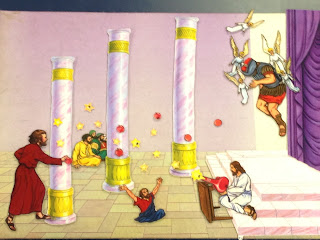
            Since Josh like flannel board stories so much, I bought him a huge set of Bible flannel board pieces.  I thought it would be a great way for Josh to learn some Bible stories. He loved it!  As my oldest child, I thought he might like to teach some of these stories to his younger sisters and it would be good practice for his oral language skills, too.  Josh dutifully repeated the story I taught him, and then devoted his energy to expressing his creativity and imagination.
Another flannel board battle ensued each time the carefully organized Bible set was brought out for a new story.  I am a Mom who likes things to be in their proper place, and the flannel board set had outlines of the pieces on each storage board which greatly appealed to my desire to have things organized.  Josh, however, liked to select pieces for his stories willy-nilly and (gasp) even took pieces from different boards and stories that were not grouped to together.  He even mixed up the Old and New Testament pieces.  It was horrible!  Okay, it is probably not that big a deal to most people, but it was a battle for me to give up my neatly arranged flannel board pieces so that Josh could express his God-given creativity.

         
      Josh is now a young adult, but he still remembers the flannel board stories with great fondness.  He remembers making up many adventurous tales and having a lot of flannel pieces to work with from our large Bible flannel set.  His favorite, he recalls, was the time he put the kneeling Jesus figure behind a  large clay jar on a table turned on its side to provide cover.  From that position, Jesus proceeded to shoot stars at his disciples across the room.  And so it went in the imagination of a young boy, who believed that Jesus could do anything including spraying stars wherever He wanted them to go.


            Whereas some people lament their lack of creativity, Josh and other outside the box type of thinkers find they have to stifle their creative urges many times throughout the day.  It was always a challenge for me to find good boundaries that allowed Josh to follow his many ideas that led him in a myriad of directions while redirecting him to get his school work completed.  Getting the academic work done did take us longer on some days when Josh pursued some of his imaginative ideas, but I wouldn’t squelch the creativity of my son for anything. 

Friday, May 11, 2012

On The Road Again


This is the time of year when I do the most traveling to conferences and conventions.  This weekend I will be at the CHAP conference with Pennsylvania home educators.  This has always been a busy conference with the opportunity to see some familiar faces and meet new people.  This year I am accompanied by my husband, Scott, and two of our three children.   

Since my son, Josh, has been the inspiration and field tester for many of the ideas and strategies I’ve tried over the years I am always happy when he attends conferences with me so attendees can speak to him and gain access to a struggling student’s perspective.  My daughter, Beckie, has likewise tried out most of the products that Heads Up carries.  I have grown in my understanding and knowledge of learning challenges over the years and I am thrilled when I can help others as they try to make decisions to help their own children.  I have been around the block (on my knees in desperate prayer at times) as a Mom seeking help and answers.  Even so, I think it can be very encouraging for people to talk to Josh and Beckie about their personal challenges with Attention Deficit Hyperactivity Disorder, Auditory Processing Disorders, Sensory Processing Disorders, and homeschooling with a Mom whose learning style is very different from theirs. 

Josh and Beckie are the true experts, because they live with the challenges and understand the struggles and feelings students may face.  They can share firsthand what did and did not help them, and in many cases what they were thinking when they engaged in some quirky behavior or other.  You could ask me for my thoughts on why your child engages in a certain behavior, and I could give you my theories based on years of personal experience and similar situations I’ve encountered as a speech/language pathologist working with children.  You could learn as much or more if you ask Josh the same question and see immediate insight because he remembers what it felt like to be that kid who can’t sit still or pay attention or remember what comes so easily for others.   

You can ask me how I helped my daughter Beckie meet her need for sensory input and I could tell you strategies I used such as suspending a swing in the doorway for her.  Beckie, though, can tell you what swinging does for her and why she seeks it out along with other ways she meets her need for sensory input from a first person perspective.  Scott and I hope and pray to help people we meet in our travels, and Josh and Beckie willingly share their lives to help others who are struggling learners.  If you are attending the CHAP convention this weekend, please take advantage of this opportunity to talk to any of us.

Now, lest you think we have our collective act all together and will be telling you why we are so amazingly successful, let me see if I can readjust your expectations so you will be neither surprised nor disappointed.  We have been traveling to conferences for the past 15 years or so and have NEVER made it to a single destination and back without at least one of us either forgetting or losing something.  Our pre-conference hours are spent like a clutch of chickens running around with their heads cut off.  Seriously, you’d think we’d never prepared for a conference before.  

 Just this morning I asked Beckie if she was packed for our trip, since I had prompted her last night to pack as much as she could in advance. She smiled sweetly and said “Yep!  I’m pretty much all packed except for my clothes.”  

Then she gestured toward the washing machine to let me know where her clothes currently resided, and happily turned and walked away.  Now picture me standing in the middle of my kitchen with my mouth hanging open trying to process how one could be “pretty much packed” without including clothes.  

 There!  Now I think you are ready to meet the real Boring family, unplugged!

-Melinda (AKA Heads Up Mom) 

Monday, August 16, 2010

Greek Mythology - or is it "miss-ology"?

A few years ago I did a unit on mythology as part of our homeschool curriculum. We learned about Greek mythology as well as mythology that originated in various other parts of the world. Although I found some of the stories to be kind of creepy at times, there's no question that it held the interest of my children. Still, when you have struggling learners even interesting materials tend to be remembered more in general terms than with specific details. My daughter, Beckie, who has AD/HD also has working memory challenges. Allowing her to draw some of the mythological characters helped her to keep them all straight in her mind. She's very creative and artistic, so drawing appealed to her and was a good challenge as she attempted to sketch some very unique creatures. Children with learning differences often struggle to generalize information they have learned. Admittedly, there's not a high need for generalizing information gleaned from Greek mythology so I didn't worry about it too much. I just wanted my children to have a basic understanding and a frame of reference when mythological characters were mentioned in literature and other media. I also taught my children about foreshadowing in literature, so one day when I was reading aloud to Beckie from a non-mythology book I paused and asked her a question about what was read. She made a good prediction about what might happen later on in the story, and I asked her how she figured that out in hopes that she would respond that she recognized the foreshadowing that had just occurred. Instead, Beckie proudly announced, "I'm Cyclops!" I was baffled for a minute, and sat there in stunned silence trying to figure out where that answer came from. Since she does not have one eye in the middle of her forehead and is actually quite lovely, to describe her as "Cyclops" clearly didn't fit. I could not recall that Cyclops were known for recognizing foreshadowing, either. As I rolled possibilities around in my head, an idea struck me and I asked Beckie, "Do you maybe mean 'psychic'?" and she laughed and said that was it. She couldn't recall the term "foreshadowing", so pulled up a word that sort of fit. I love my Beckie for not being afraid to give things her best shot. She's confident and can laugh at herself, even as she boldly attempts to answer questions that she does not have a precise answer for. Let's hear it for all the children like Beckie who try and try again, and who don't let mistakes prevent them from offering their answers and making contributions.

Tuesday, April 27, 2010

Please Try Again


Sometimes companies use the marketing strategy of offering the possibility, in addition to enjoying their fine products, of actually winning additional prizes. The prize offerings are often in the form of financial winnings, but may include the lure of exotic vacations or new cars. I don't buy products just because they offer the potential for prizes, but if it's something I would buy anyway I certainly take the time to read the bottle top, box flap, or inside the bag to see if I've won anything. (So far, nothing, but I'm only middle-aged so I guess it could still happen!) Usually, my message reads something like, "Please try again" or "There are many chances to win" (insert here, but you probably won't) so...please try again. It doesn't surprise me when I don't win, since the odds are against it and it's not like I'm trying day after day to strive for a prize. One day, though, I was feeling a little discouraged and opened a wrapper without realizing it was one of those "might win a prize" wrappers. When I read, "SORRY YOU DIDN'T WIN!" it was like an unexpected dig. "Wait a minute!" I cried out in my mind. "I wasn't even trying to win that time!" In my discouragement the message translated into "SORRY YOU ARE A LOSER! AGAIN! AND PROBABLY ALWAYS WILL BE!" Gee, and I just wanted a little treat.

I started thinking about the messages we communicate, and how our struggling learners might be translating them. I might say, "That was a good try" and my child might mentally translate that into, "I did it wrong again". I can see how easily my own perfectionist tendencies might be perceived by my children as "Nothing is ever quite good enough." I can say, "Let's keep working on this" and "Work hard and do your best", but depending on the child's temperament and interpretation of my tone of voice it might be perceived as criticism rather than encouragement. For most of us, we can shrug off those "You are a loser" messages and get on with life. For those with learning disabilities who struggle, day after day, with tasks that are unavoidable and reoccurring, it is harder to ignore and resist that message. Day after day, they struggle to complete work. A math fact or phonics rule they "knew" yesterday eludes them today. They do not know why, they cannot explain it, yet they experience the frustration of having material seemingly evaporate before they can nail it down. So they start the learning process over, or repeat work that in their minds they believe they should already know. They notice that other people seem to have it much easier, and even when no one else says it they draw the conclusion "I am not a winner". Every day, it's like they are opening the wrapper or bottle to see if today they will be a winner. Over time, resignation sets in along with the belief that winning is for someone else.

There are no easy answers here. I have no quick fix to offer, or sure-fire rapid remedy to make your child feel like a winner. Every child is different, as are teachers, parents and families. What I can offer is more of a life strategy, a paradigm shift that views struggles as a part of life. I shared my own struggles with my children (at age-appropriate levels) and taught them that everyone has strengths and weaknesses. Some are more visible than others, but the fact is that we all need others who are strong where we are weak. Likewise, we all have something to offer. I believe that beyond a shadow of a doubt, and I shared that belief over and over with my children. I made it a point to focus on the whole child, not just the academic areas and disabilities and differences. Despite the diagnosis, I would not allow my children to use it as an excuse for not developing good character traits or not doing as much as they were able to. Are some things harder for you than others? Do you sometimes feel like you are a loser? Sure. Does that feeling make it true? Absolutely not. Speak the truth to your children, boldly and repeatedly. Say it out loud so they can hear your own mental battle resolve. It might sound something like this: "I sure have a hard time doing this, and other people make it look easy. Sometimes I feel like a loser. But you know what? I'm not! Even though I might feel like a loser, I know I have a lot to offer. Nobody is good at everything and I'm not, either. But that doesn't make me a loser." By talking it through, your children are learning from you. They will see how you acknowledge an emotion and tackle a thought that is not healthy or true. Over time, they will learn how to battle the "I am a loser" notion with the truth that they are individuals with great worth and value in many ways. Next time you get the message "SORRY YOU DIDN'T WIN!" think about translating that into a message that reflects gratitude and appreciation for all you have to offer. Be resilient and teach your children to be resilient. Don't fall for the "You are a loser" message. The next time you are faced with a challenge, "Please Try Again", because there truly are many chances to win.

Saturday, March 06, 2010

Right Brain Learners

The "right brain" learners tend to see the big picture and don't focus on all the details. These are the students who take a more gestalt approach to learning. With my right brain learners, I've found that they are satisfied if they just get the gist, and "close enough" is good enough for them. I may have been a bit too successful in not passing along my own perfectionist tendencies! I am also a "left brain" learner, preferring to do things in a logical sequence with attention to detail. This video is a reenactment of part of a geography lesson I did with my daughter, Beckie, who is definitely presenting as a right brain learner. I hope you enjoy this clip of "right" meets "left" during our homeschooling moments. For more ideas about working with your "right brain" and "left brain" learners, see my workshop "Adapting Curriculum for Learning Differences".