
Do you have a child who can always pay attention, sit still,
and comply with directions and requests?
If so, you may not be able to identify strongly with this post. On the other hand, you may have other children
someday or know of some who are similar to my son, Joshua. My son has always been an “outside the box”
kind of thinker. He is so far outside
the box that he doesn’t know the box exists.
He thinks in terms of what is possible, rather than being limited to
pre-existing established patterns. To
say that Josh is a non-conformist would be a gross understatement. This kid doesn’t just march to the beat of
his own drum; he marches to the beat of his own oboe or something. His creative thinking made his behavior
unpredictable at times, which in turn made parenting him very challenging. Can you relate?
I am a
pretty linear thinker, and although I’d like to think that my box is large I am
definitely an “inside the box” kind of thinker.
This was one of the challenges I faced in parenting Josh, because my own
responses to situations were logical and predictable to anyone who knew
me. Even though I tried I just could not
anticipate how Josh would respond in many situations. Novel experiences were the most
unpredictable, and I’m sure that even Josh did not know what he was going to
say or do in advance much of the time.
For
example, our local library had weekly story times for preschoolers, and Josh
looked forward to attending each program.
Josh tended to observe rather than take part with most of the activities,
though. He sat on my lap and watched the
other children sing songs and do the motions to finger plays. When the librarian read books, Josh would
push forward to get a better view of the pictures, but he usually sat on his
knees so he wasn’t blocking others’ views.
For Josh, the true highlight of each week was the flannel board story.
The
librarian would tell a familiar story, using the flannel board and various
flannel pieces. Even though this was his
favorite part of the 30 minute program, Josh could barely contain himself and
wiggled and hopped around while the story was being told. With frequent reminders and prompts to sit
down so that others could see, Josh waited for what he really liked best about
the flannel board.
Each story
seemed to spark ideas for a hundred others in Josh’s imagination, and our
librarian was kind enough to give Josh free reign with the flannel board
following the official story time. With
or without participation by others, Josh would tell his original stories or
take the existing story and give it multiple alternative plots and
conclusions. Inevitably, Josh’s stories
would include a battle of some sort. He
could take the most peaceful setting and turn it into an epic battlefield.


Since Josh
like flannel board stories so much, I bought him a huge set of Bible flannel
board pieces. I thought it would be a
great way for Josh to learn some Bible stories. He loved it! As my oldest child, I thought he might like
to teach some of these stories to his younger sisters and it would be good
practice for his oral language skills, too.
Josh dutifully repeated the story I taught him, and then devoted his energy to expressing his creativity and imagination.
Another flannel board battle ensued
each time the carefully organized Bible set was brought out for a new
story. I am a Mom who likes things to be
in their proper place, and the flannel board set had outlines of the pieces on
each storage board which greatly appealed to my desire to have things
organized. Josh, however, liked to
select pieces for his stories willy-nilly and (gasp) even took pieces from
different boards and stories that were not grouped to together. He even mixed up the Old and New Testament
pieces. It was horrible! Okay, it is probably not that big a deal to
most people, but it was a battle for me to give up my neatly arranged flannel
board pieces so that Josh could express his God-given creativity.

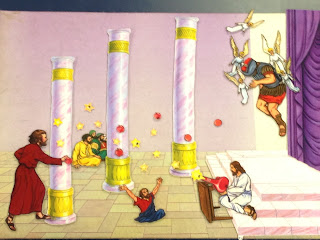
Josh is now a young adult, but he still remembers the flannel board stories with great fondness. He remembers making up many adventurous tales and having a lot of flannel pieces to work with from our large Bible flannel set. His favorite, he recalls, was the time he put the kneeling Jesus figure behind a large clay jar on a table turned on its side to provide cover. From that position, Jesus proceeded to shoot stars at his disciples across the room. And so it went in the imagination of a young boy, who believed that Jesus could do anything including spraying stars wherever He wanted them to go.

Whereas
some people lament their lack of creativity, Josh and other outside the box
type of thinkers find they have to stifle their creative urges many times
throughout the day. It was always a
challenge for me to find good boundaries that allowed Josh to follow his many
ideas that led him in a myriad of directions while redirecting him to get his
school work completed. Getting the
academic work done did take us longer on some days when Josh pursued some of
his imaginative ideas, but I wouldn’t squelch the creativity of my son for
anything.


